How to Link Strategic Partners: Digital Infrastructure for Professional Networks
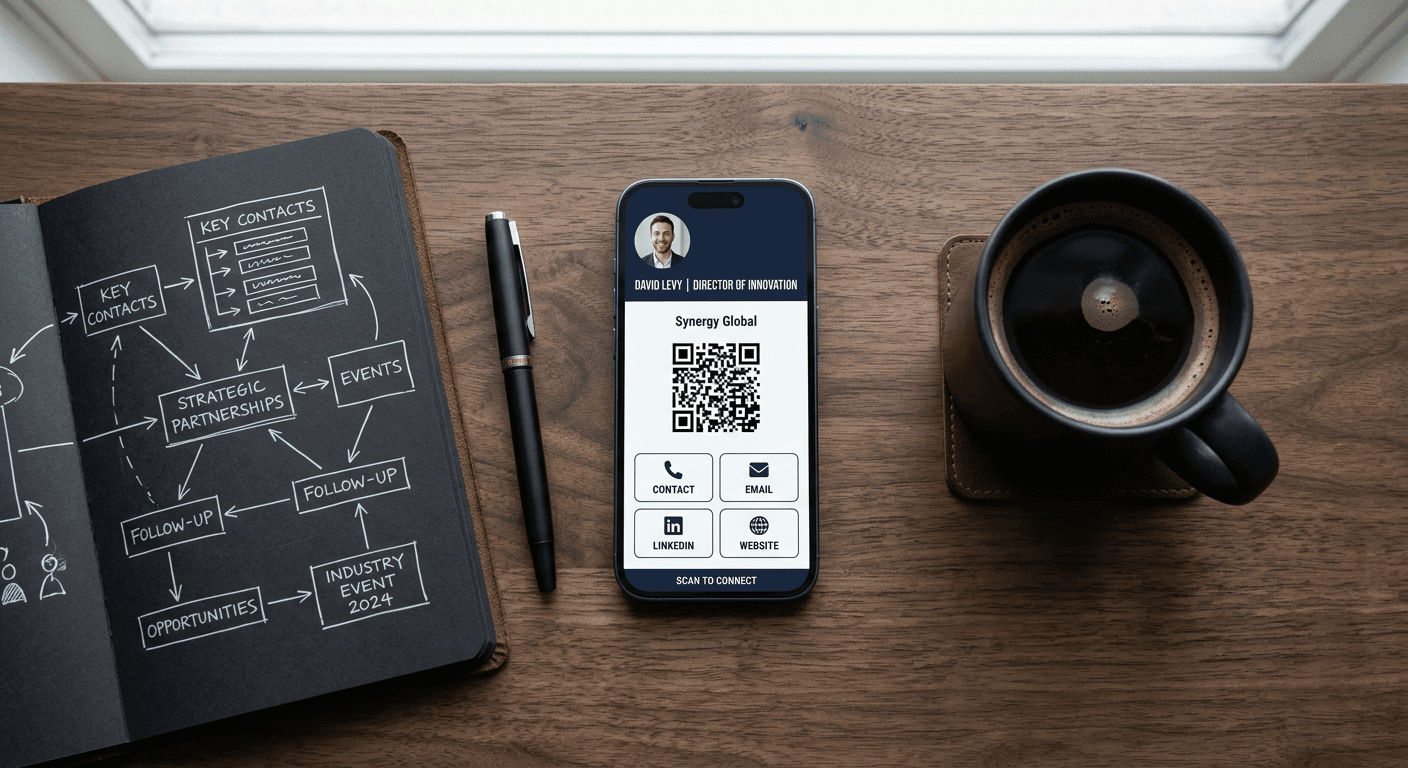
A partnership director returns from an industry conference, exports a spreadsheet of 400 new contacts, and tags them in a CRM. Six months later, fewer than five of those connections have yielded an active collaboration. The failure here is not a lack of shared interest, nor is it poor conversational skills; it is a failure of digital infrastructure. Treating a professional network as a static address book guarantees stagnation. To genuinely link strategic partners, organizations must shift from passively storing contact information to building active digital routing systems. The lens for evaluating your connection practices is simple: if a new contact cannot self-serve their way to understanding your core value proposition and initiating a collaboration within three clicks, your digital handoff process is broken.
Quick Summary
Digital networking infrastructure replaces static contact exchanges with centralized, trackable routing pages that drive professional engagement. Consolidating your digital footprint ensures that new connections can asynchronously discover your work and initiate partnerships without friction.
- Static contact records decay rapidly; dynamic routing pages shift the maintenance burden away from your CRM.
- Fragmented digital footprints confuse potential partners and dilute your core value proposition.
- Centralized links act as single digital business cards, capturing analytics on partner engagement.
- Dedicated internal teams must standardize how external-facing staff distribute digital assets.
Table of Contents
- Why Passive Contact Storage Fails Professional Networks
- Where Digital Handoffs Break Down
- Centralizing Identity With Unified Link Up Solutions
- Deploying a Strategic Link Building Solution
- Organizing an Internal Link Construction Group
- Streamlining the Link Recruit Process
- Comparison Table: Static vs Active Networking
- FAQ
- Recommended Reads
Why Passive Contact Storage Fails Professional Networks
The traditional approach to professional networking treats connections as discrete data points to be captured and stored. You scan a badge, receive a business card, or connect on a social platform, and that interaction is logged in a centralized database. The fundamental mechanical flaw in this approach is data decay.
When you rely on a static CRM record, the burden of keeping that information accurate falls entirely on your organization. As professionals change roles, shift companies, or abandon specific communication channels, the stored data silently expires. A digital connection requires active infrastructure, not a digital filing cabinet. The alternative is shifting from a push model - where you must manually reach out to dormant contacts to verify alignment - to a pull model. By maintaining a dynamic, public-facing routing page that clearly articulates your current offerings, you allow partners to self-qualify and initiate contact when the timing is right for them.
This shift requires moving away from the assumption that a successful interaction ends with a stored phone number. Instead, the goal is to leave the counterpart with a persistent, updated pathway back to your ecosystem.
Where Digital Handoffs Break Down
"The lead went cold" is not a diagnosis. When promising physical interactions fail to translate into digital collaborations, the breakdown typically occurs in one of three distinct failure modes. Each requires a different structural fix.
The Fragmented Footprint
Many professionals follow up by sending a scattered array of links: a LinkedIn profile, a corporate homepage, a scheduling link, and a PDF attachment. This forces the recipient to act as a project manager just to understand the pitch. Cognitive load kills conversions. When a potential partner is forced to parse multiple disjointed resources, they usually abandon the effort entirely.
Friction-Heavy Onboarding
A second failure mode occurs when organizations gate their partnership criteria behind synchronous meetings. Requiring a new contact to book a thirty-minute discovery call simply to learn if a partnership makes structural sense introduces unnecessary friction. Modern professionals prefer asynchronous discovery. They want to read your partnership terms, view your portfolio, and evaluate your capabilities on their own time before committing to a calendar block.
Missing Connective Agency
In network theory, connective agency refers to the structural capacity of an environment to bridge the gap between two isolated nodes without manual intervention. A physical business card lacks this entirely. If a counterpart loses the physical card or forgets the context of the meeting, the link is severed. Digital systems fail similarly when they lack analytics. If you send a standard URL, you have no visibility into whether the partner opened it, which specific resources they viewed, or where their attention dropped off. You are navigating the relationship blind.
Practical rule: Never send more than one URL in a follow-up message. Force yourself to consolidate the necessary resources behind a single routing page, ensuring the recipient has exactly one clear path forward.
Centralizing Identity With Unified Link Up Solutions
To eliminate the fragmented footprint, organizations are increasingly adopting consolidated routing pages. These single-page, mobile-optimized interfaces serve as a digital lobby, directing traffic to specific, highly relevant destinations.
Implementing these link up solutions effectively requires understanding the trade-off between standard vCard encoding and dynamic URL routing. When a QR code is encoded directly with vCard data, scanning it instantly prompts the user's phone to save a contact file. However, that file is permanently static; if you change your phone number the next day, the partner's phone is not updated. Conversely, when a QR code points to a centralized routing URL, the initial scan requires an internet connection and a browser load, but it guarantees the partner is always viewing your most current information, current campaigns, and active scheduling links.
The most effective implementation uses the URL routing method, ensuring that every touchpoint points back to a centralized hub you control. This allows you to update your featured projects, swap out promotional banners, and adjust partnership criteria instantly without ever having to notify your network of a change in your underlying contact details.
Deploying a Strategic Link Building Solution
While typically associated with search engine optimization, a genuine link building solution in the context of professional networking refers to designing intentional digital pathways between distinct business entities. It is about how you deploy your routing pages across various mediums.
The mechanics of tracking these pathways rely heavily on UTM (Urchin Tracking Module) parameters and specific referrers. If you attend three different trade shows in a quarter, handing out the exact same un-tagged URL makes it impossible to measure which event generated the highest quality partnerships. By generating distinct URLs or specific QR codes for each event - all routing back to the same master landing page but carrying different tracking tags - you gain immediate visibility into the ROI of your physical networking efforts.
This deployment strategy separates sophisticated networkers from amateurs. When you can definitively state that a specific conference generated 400 page views, 50 clicks on your partnership criteria, and 12 booked meetings, you transition networking from an intangible art to a measurable business process.
Organizing an Internal Link Construction Group
The technical deployment of routing pages is straightforward; the organizational governance is not. Left to their own devices, sales teams will use one scheduling tool, marketing will deploy a different analytics tracker, and executive leadership will rely on outdated corporate bios. This fragmentation bleeds into the external partner experience.
To prevent this, organizations must establish a cross-functional link construction group. This is an internal task force - usually comprising operations, marketing, and partnership managers - dedicated to standardizing the company's digital handoff assets. This group dictates which links are permissible on the routing pages, establishes brand guidelines for digital business cards, and reviews the analytics to determine which calls-to-action are performing best.
The primary trade-off here is control versus personalization. A highly centralized group ensures brand safety and consistent analytics, but it can frustrate front-line networkers who want to customize their pages for specific niche events. The most functional compromise is a templated approach: the central group locks the core branding and primary data-capture forms, while leaving a few flexible modules that individual users can tailor to their specific industry verticals.
Practical rule: Audit your team's email signatures and social media profiles quarterly. If you find more than two distinct platforms being used to host digital business cards or scheduling links, mandate a migration to a single centralized tool.
Streamlining the Link Recruit Process
Once the digital infrastructure is centralized and tracked, it can be leveraged to actively intake new collaborators. The traditional method of onboarding an affiliate, sponsor, or strategic vendor requires manual back-and-forth emails, NDA exchanges, and discovery calls.
Modern digital networking applies a link recruit workflow to automate the earliest stages of this relationship. Instead of pitching a partner and waiting for an email response, you direct them to a dedicated intake module on your routing page. This module outlines the baseline requirements for a partnership, provides downloadable media kits, and houses a conditional logic form. If the prospective partner does not meet your minimum criteria, the form politely declines the application without consuming your team's time. If they do meet the criteria, the system automatically routes their data into your active pipeline and triggers a calendar invitation.
This asynchronous discovery process respects the partner's time while ruthlessly protecting yours. It shifts the dynamic from "let's get on a call to see if there is a fit" to "review our structural requirements, and if you align, the system will initiate the next step."
Comparison Table: Static vs Active Networking
The distinction between traditional contact storage and active routing infrastructure impacts every phase of relationship management.
| Dimension | Static Contact Storage | Active Digital Routing |
|---|---|---|
| Data Maintenance | Relies on manual updates by the CRM owner as contacts decay. | Relies on the user updating their own centralized hub. |
| Handoff Friction | High; requires parsing multiple attachments and disconnected URLs. | Low; a single link consolidates all relevant pathways. |
| Engagement Tracking | Blind; no visibility into what happens after a card is handed over. | Trackable; analytics reveal clicks, traffic sources, and behavior. |
| Partner Discovery | Synchronous; requires booking a meeting to determine mutual fit. | Asynchronous; partners self-qualify via published criteria. |
| Physical Integration | Paper business cards that are easily lost or mistranscribed. | QR codes that bridge offline meetings instantly to online hubs. |
FAQ
What makes a single routing page better than linking directly to a corporate website? Corporate websites are designed for broad audiences and complex navigation. A routing page acts as a targeted menu, distilling your online presence down to the 3-4 specific actions you want a strategic partner to take, thereby drastically reducing cognitive load and drop-off rates.
How do UTM parameters work on a digital business card?
UTM parameters are text tags appended to a URL. When you generate a QR code for a specific event, you attach a tag (e.g., ?utm_source=q3_conference) to your routing link. Your analytics dashboard then reads this tag, allowing you to filter exactly how many page views originated from that specific room.
Why is vCard data inferior to a dynamic routing link? When a user downloads a vCard to their phone, the data is frozen in time. If you change your booking software or phone number a month later, the partner's phone retains the old data. A dynamic link ensures they load your current profile every time they click.
Who should avoid using centralized routing pages for networking? Professionals in industries with extreme regulatory constraints regarding digital communication (such as heavily restricted defense contracting or specific financial compliance sectors) may find that hosting third-party consolidated links violates data perimeter policies. In those instances, strictly controlled, internally hosted landing pages are required.